
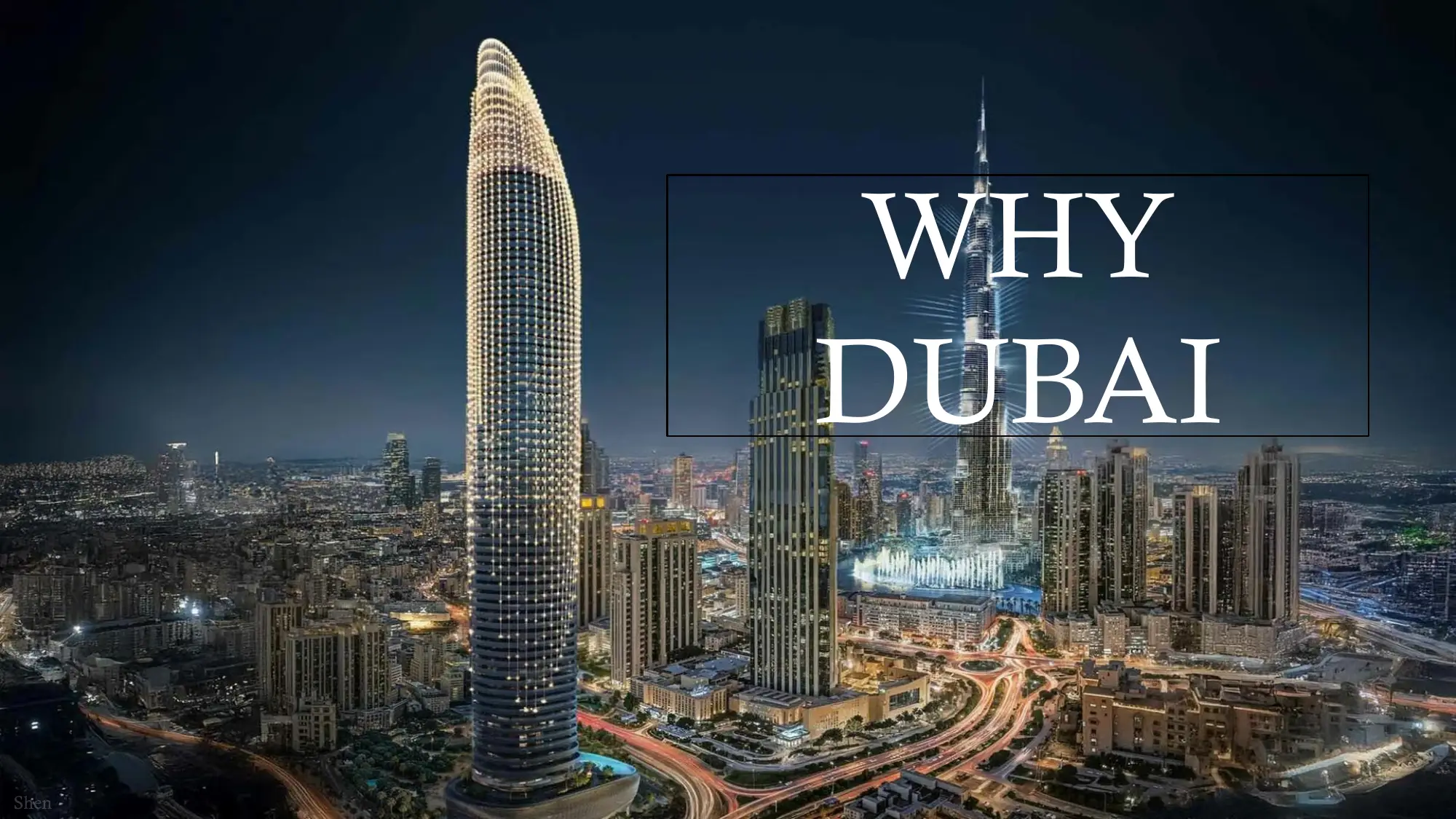
Why Dubai
A City of Continuous Growth, Opportunity, and Investment
Dubai has transformed from a modest desert port into one of the world’s most dynamic global cities in just a few decades. The sections below set out why the emirate continues to attract investors, residents, and businesses from around the world — from its economy and infrastructure to its real estate fundamentals.
United Arab Emirates & Dubai: Continuing to Grow
The UAE and Dubai are both on a sustained growth trajectory across population and development.
- UAE population growth: approximately 2% per year.
- Dubai population growth: approximately 5% per year.
- Population mix: around 10% UAE nationals and 90% non-nationals — a highly international community.
- Land area: Dubai city covers about 4,114 sq km, within a total UAE land area of about 83,600 sq km.
Dubai: A Timeline of Continuous Progress
| Year | Milestone |
|---|---|
| 1960 | Dubai Airport opened to the public |
| 1971 | United Arab Emirates was founded |
| 1979 | Dubai Cable, Dubai Dry Docks, Jebel Ali Port, Dubai Aluminium and Dubai World Trade Centre |
| 1985 | Launch of Emirates Airline |
| 1990 | Two world-class ports, an international airport, Emirates Airline, and the Jebel Ali Free Zone |
| 2000 | From 180 hotels and 44,000 rooms, Dubai grew to 681 hotels exceeding 100,000 rooms |
| 2001 | Real estate market opened to foreign investors |
| 2010 | Burj Khalifa made Dubai world-famous, attracting around 47.2 million tourists |
| 2016 | Around 83.6 million international passengers |
A Strategic Geographic Location
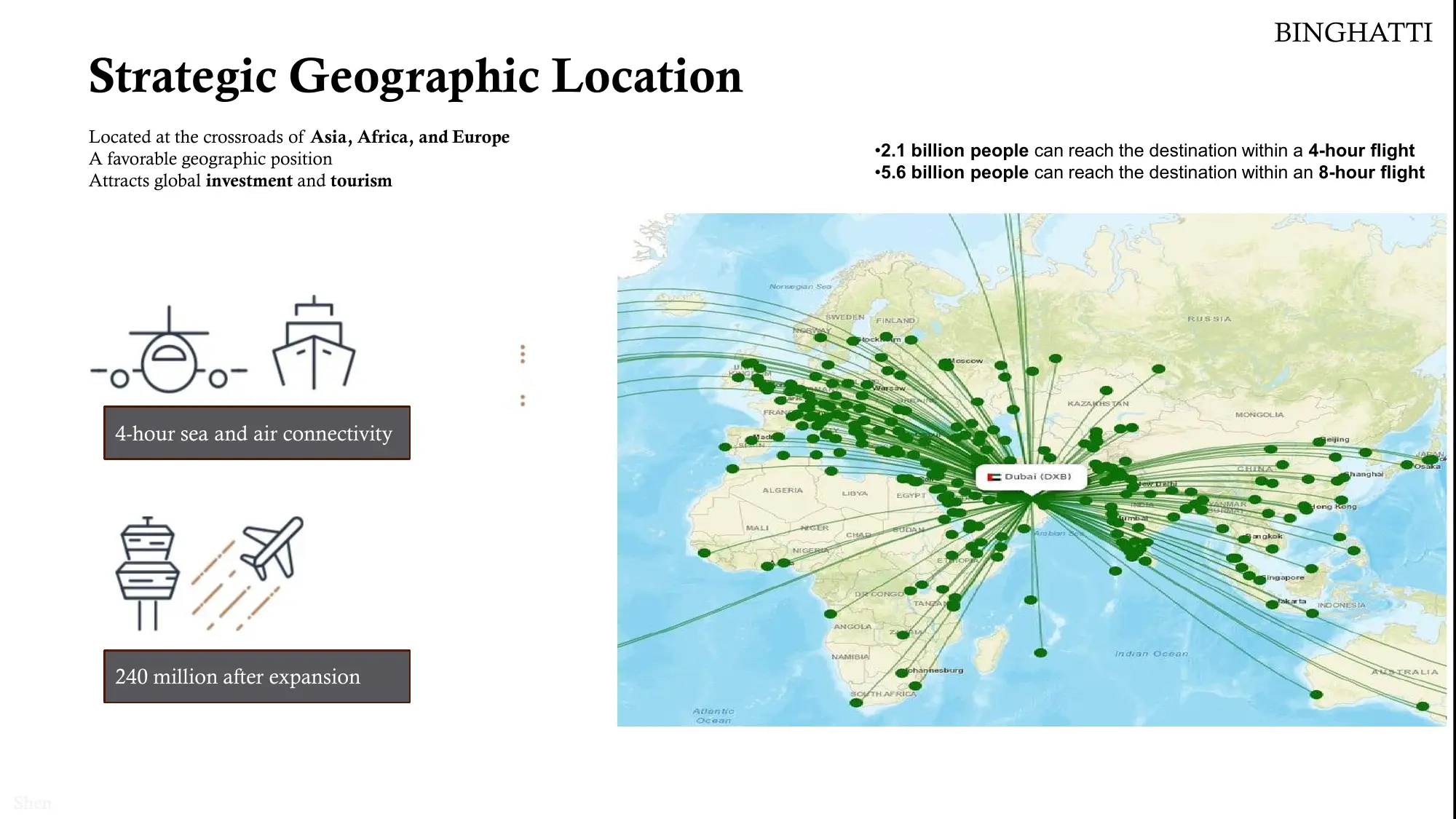
Dubai sits at the crossroads of Asia, Africa, and Europe — a favorable position that draws global investment and tourism.
- Around 2.1 billion people can reach Dubai within a 4-hour flight.
- Around 5.6 billion people can reach Dubai within an 8-hour flight.
- 4-hour sea and air connectivity to major regional markets.
- Airport capacity expanding toward 240 million passengers after expansion.
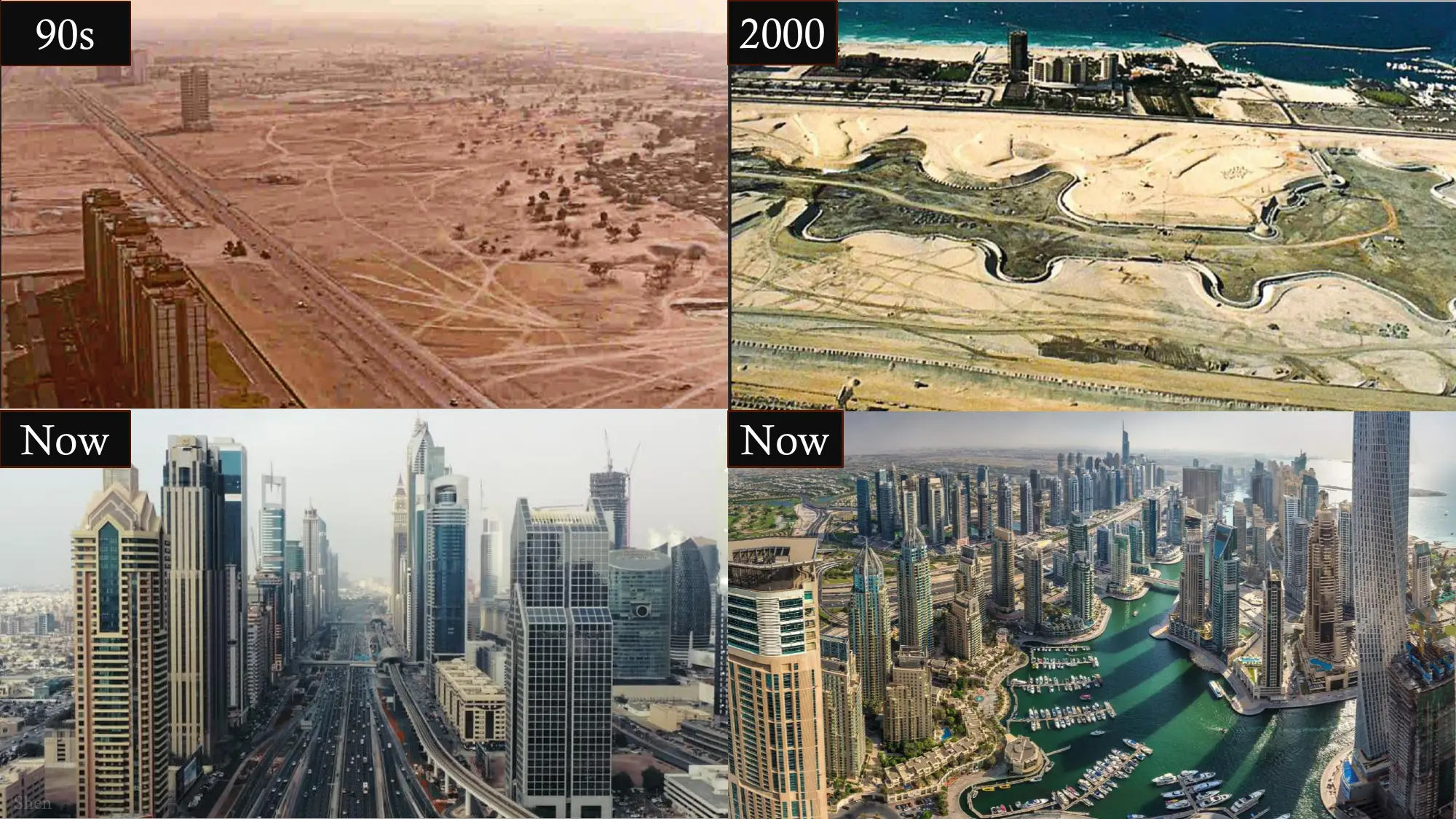
Three Decades of Transformation
The pace of Dubai’s development is best shown visually — from open coastline and desert to a dense, modern metropolis.
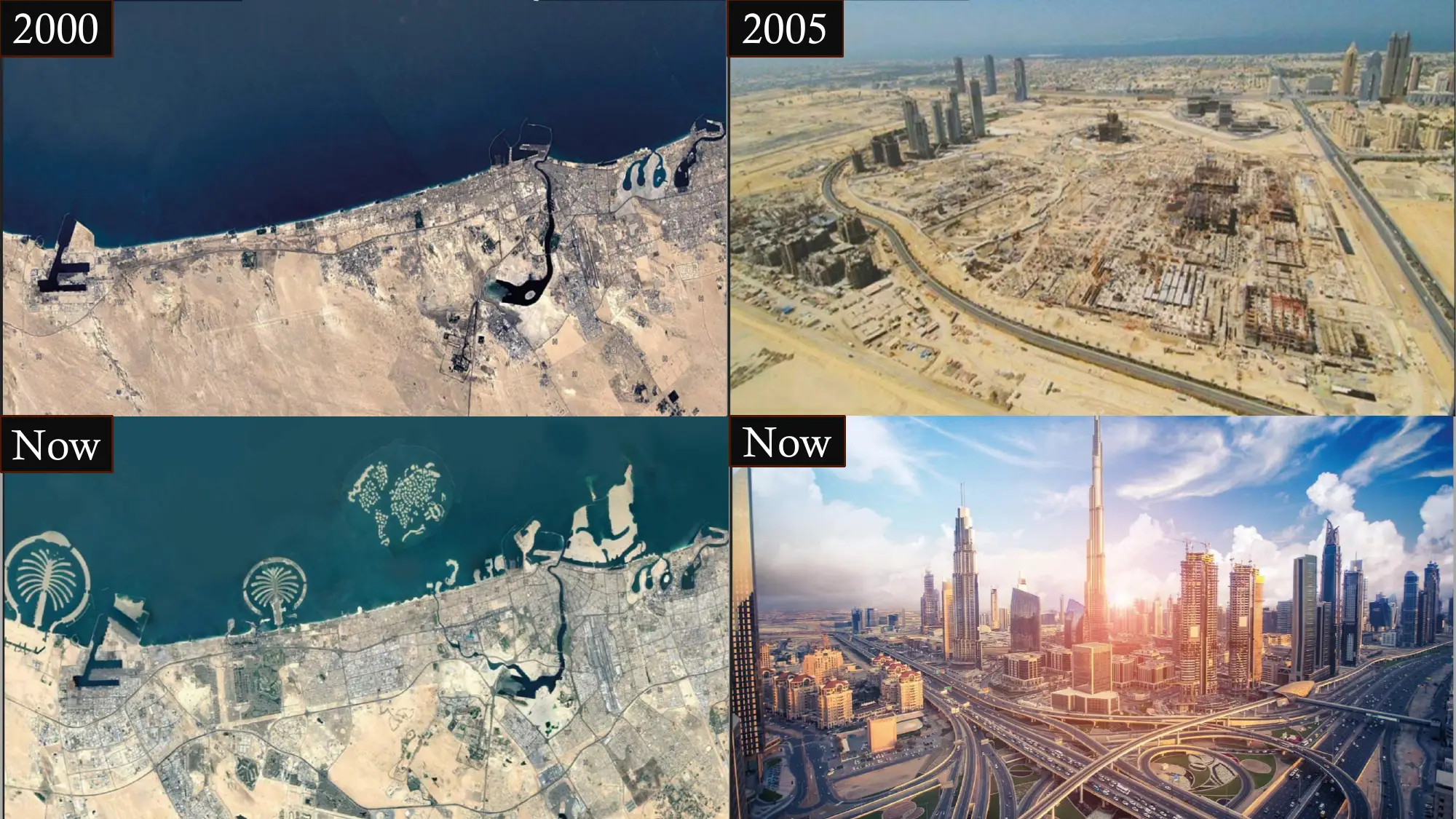
Dubai coastline and downtown: 2000 and 2005 compared with today
Dubai’s Diversified Economic Structure
- Dubai’s GDP growth rate was 6.2% in 2025.
- From January–December 2025, GDP grew by 4.6%; the National Bank of the UAE estimated full-year growth at around 5%.
- Full-year forecast: 4.4–5% (National Bank of the UAE).
- Growth exceeds the MENA regional average.
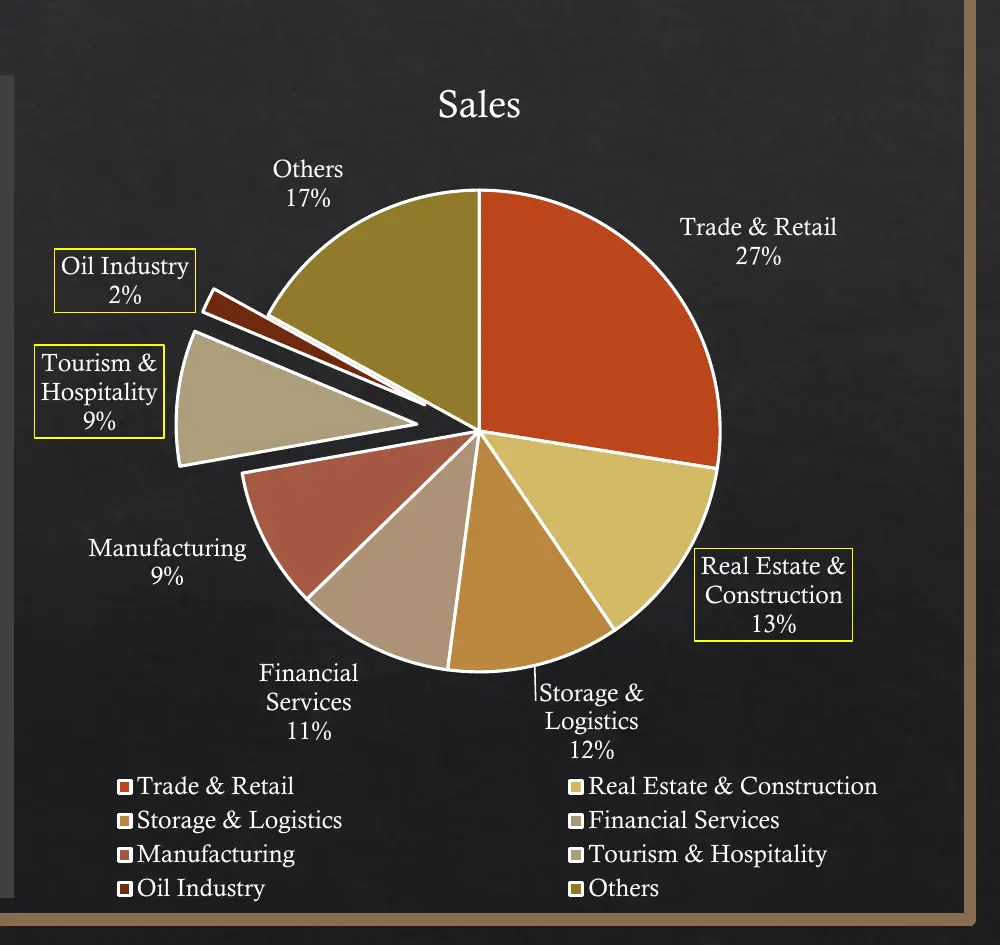
Share of the economy by sector:
- Trade & Retail — 27%
- Others — 17%
- Real Estate & Construction — 13%
- Storage & Logistics — 12%
- Financial Services — 11%
- Manufacturing — 9%
- Tourism & Hospitality — 9%
- Oil Industry — 2%
Recognised on the Global Stage
Gulf News: Dubai set to rank among the top three global travel destinations in 2025
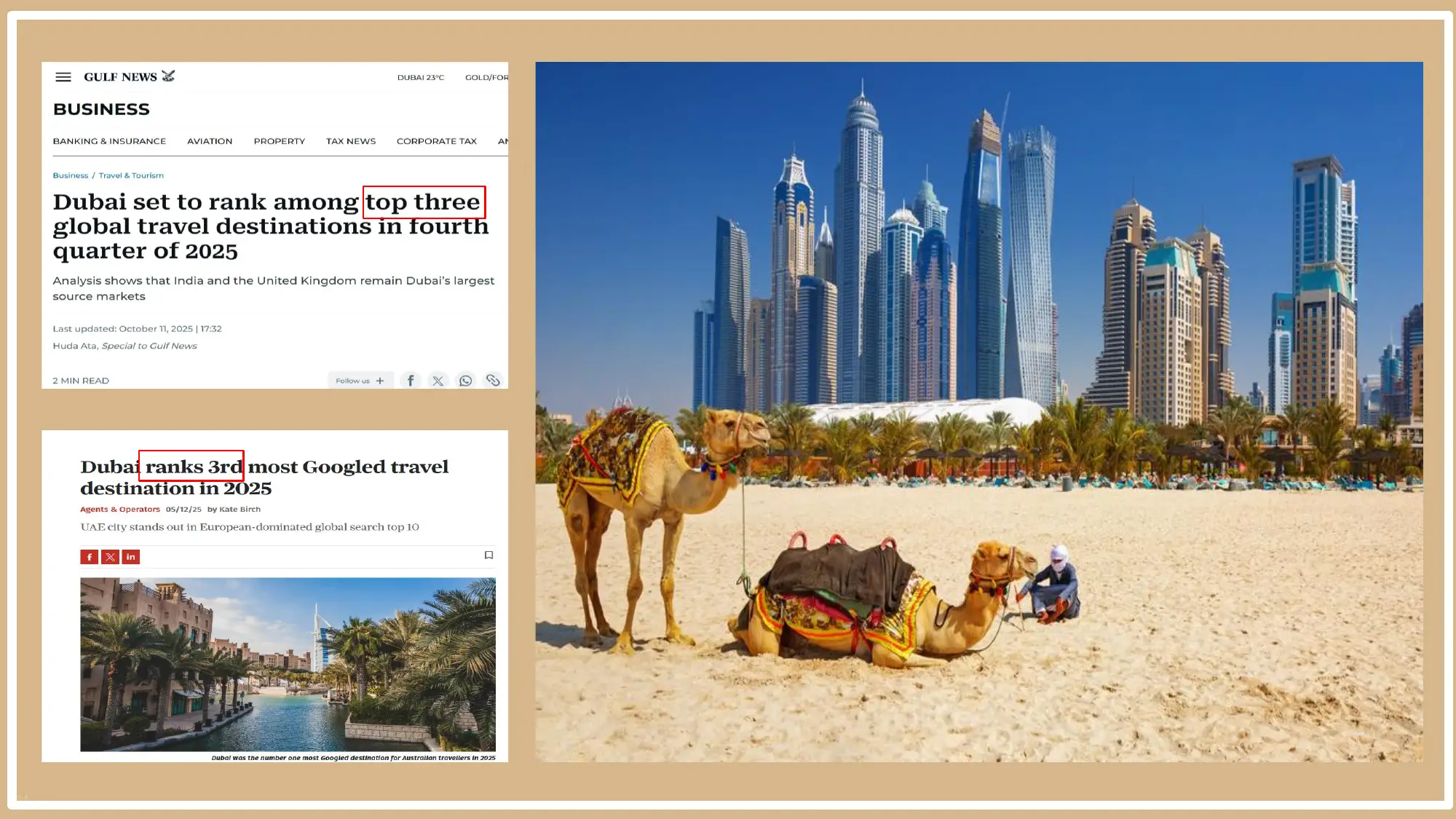
Dubai’s momentum is regularly reflected in international media and market data.
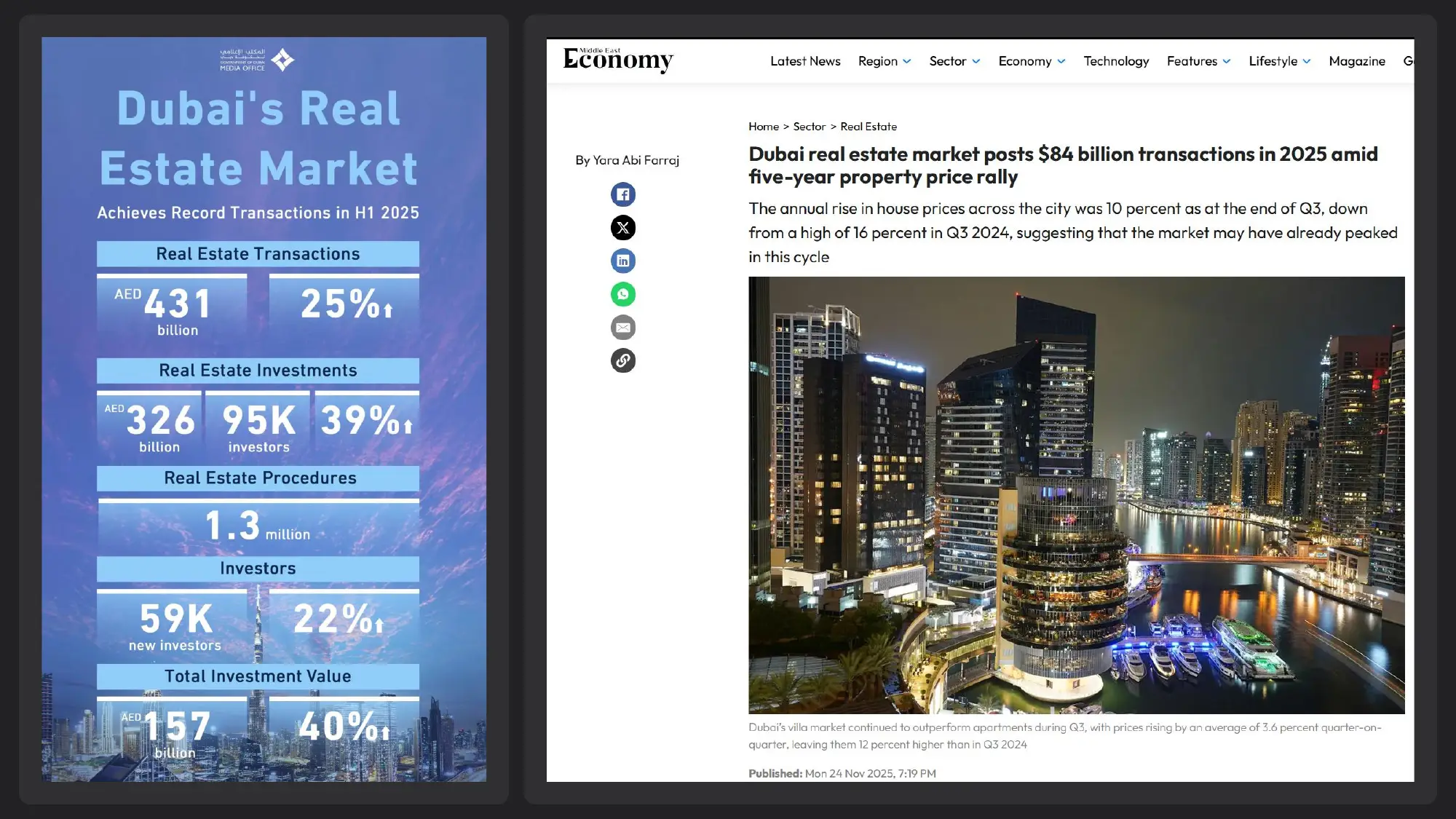
Dubai’s real estate market posted record transactions in 2025.
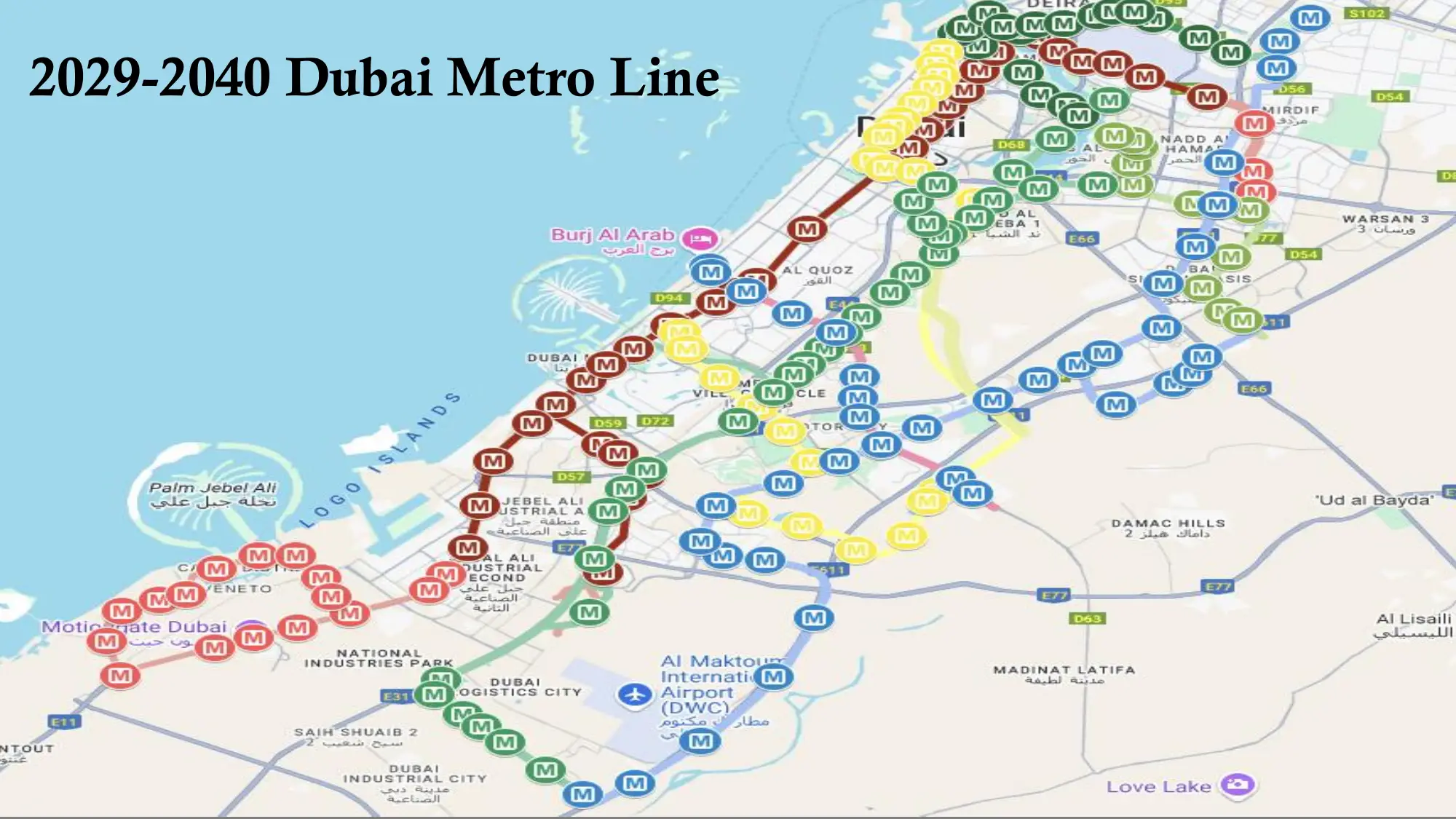
Expanding Infrastructure: 2029–2040 Dubai Metro
Dubai continues to invest heavily in public transport, with major metro expansion planned through 2040 to connect new growth corridors across the city.
Innovation in Healthcare
- 400+ medical services with internationally accredited facilities.
- 35,000+ healthcare professionals from 110 countries.
- Healthcare growth of 12.7%, reaching about USD 19.05bn.
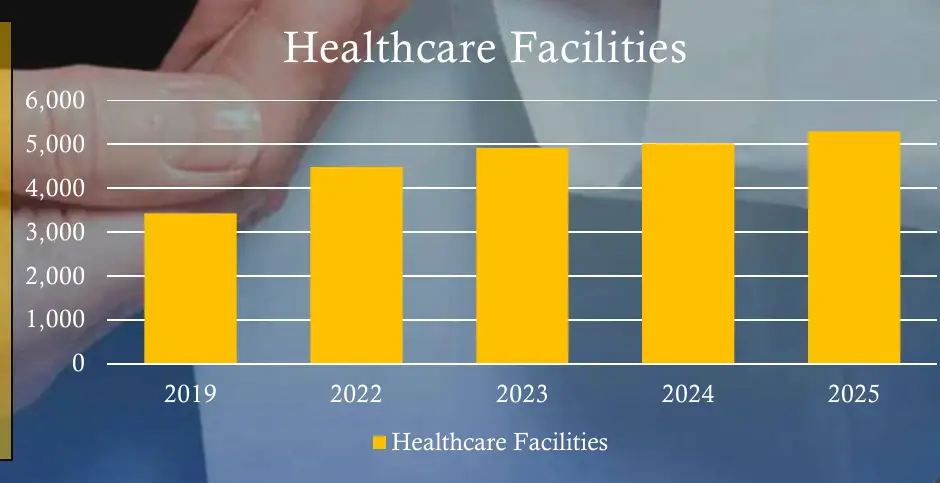
Growth in Dubai healthcare facilities, 2019–2025
Dubai Education
- Schools: 200+ international schools (including 55 British, 28 American, 8 IB, and 9 British/IB hybrid).
- Higher education: Dubai American University, University of Wollongong Dubai, Canadian University Dubai, and University of Birmingham Dubai.
- Government support: Total UAE federal budget for 2025 of AED 71.5B (~$19.5B), up from just $2.7B in 2017.
- Character: international, diverse, and globally connected.
By the numbers:
| Indicator | Value |
|---|---|
| Schools | 227 |
| Students | 387,441 |
| Teachers | 27,284 |
| Curricula | 17 |
| Quality (Good or higher) | 81% of students |
Jebel Ali Free Zone (JAFZA)
- 100% foreign ownership.
- Tax-free environment — effectively a true tax haven.
- Full repatriation of capital and profits, with no foreign exchange controls.
- Fixed AED–USD exchange rate.
- Simple procedures with minimal bureaucracy.
Political Stability & Safety
- Political stability that underpins investment security.
- Strong protection for citizens, residents, and visitors.
- Recognised as one of the cities with the lowest crime rates worldwide.
- A safe and reassuring environment for living, working, and investing.
Backed by Global Rankings
Ease of Doing Business
- UAE leads the Arab world for ease of doing business
- Dubai ranked 18th globally (2017)
- 6th for international reputation
Readiness for Reform
- Most reform-ready in the MENA region
- 3rd globally in reform readiness
- 16th in the WEF Global Competitiveness Report 2016–2017
Top Tourist Destination
- One of the world’s top tourist destinations
- 4th globally — MasterCard Global Destination Cities Index
Attractive to Ultra-High-Net-Worth Individuals
- Dubai 16th globally — Knight Frank Global Cities Wealth Index
- Highly attractive to UHNWIs
Innovation
- 14th globally — Global Innovation Index
- Among the top 30 most innovative cities worldwide
Dubai International Financial Centre (DIFC)
One of the world’s leading financial centres and the largest financial and trade hub in the region
- 2,003 registered companies and 22,768 professionals employed
Home to leading global institutions:
- 21 of the world’s Top 25 banks
- 11 of the Top 20 asset management firms
- 6 of the Top 10 insurance companies
- 6 of the Top 20 global law firms
More than 300 Fortune Global 500 companies operate in Dubai, including Deutsche Bank, Credit Suisse, Morgan Stanley, Merrill Lynch, and China’s Big Four banks.
Dubai Expo
- Total construction value: USD 42.5 billion
- Visitors received: 25 million
- Jobs created: 300,000+
- Foreign direct investment attracted: USD 100+ billion
Building the Future: Energy & Mobility
Mohammed bin Rashid Al Maktoum Solar Park
- Project area: 48 km²
- Total investment: USD 13.7 billion
- CO₂ reduction: 200,000+ tons
- Capacity: 1,000 MW (2020), targeting 5,000 MW by 2030 — about 25% of Dubai’s power demand
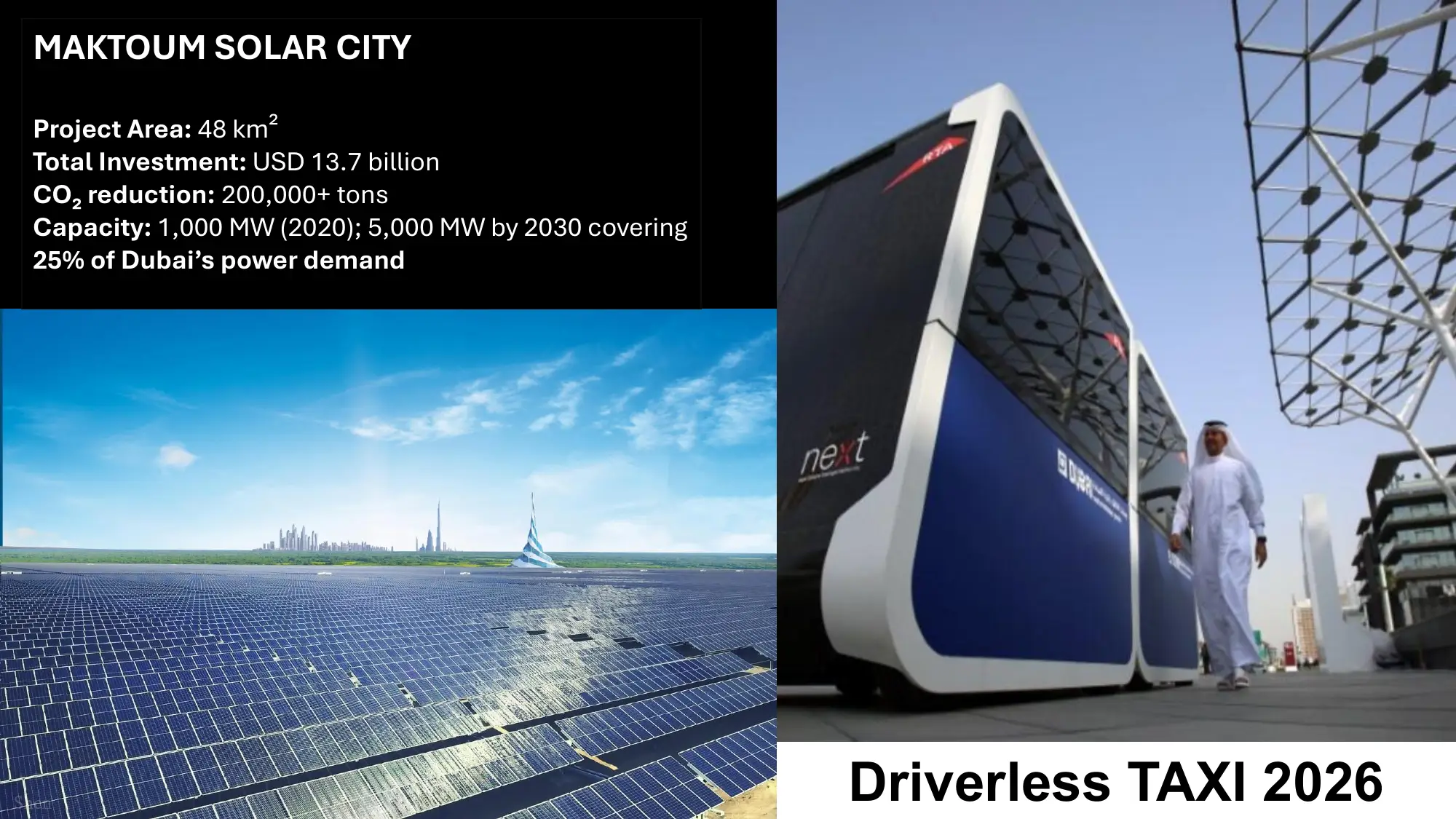
Solar Park and Dubai’s planned driverless taxi (2026)
Hyperloop (2030) & Air Taxi (2026)
- Dubai–Abu Dhabi in 12 minutes via Hyperloop.
- Speed: up to 1,223 km/h.
- Technology: magnetic levitation with low-vacuum tubes.
- Designed for ultra-high speed, high safety, low energy use, and minimal noise.
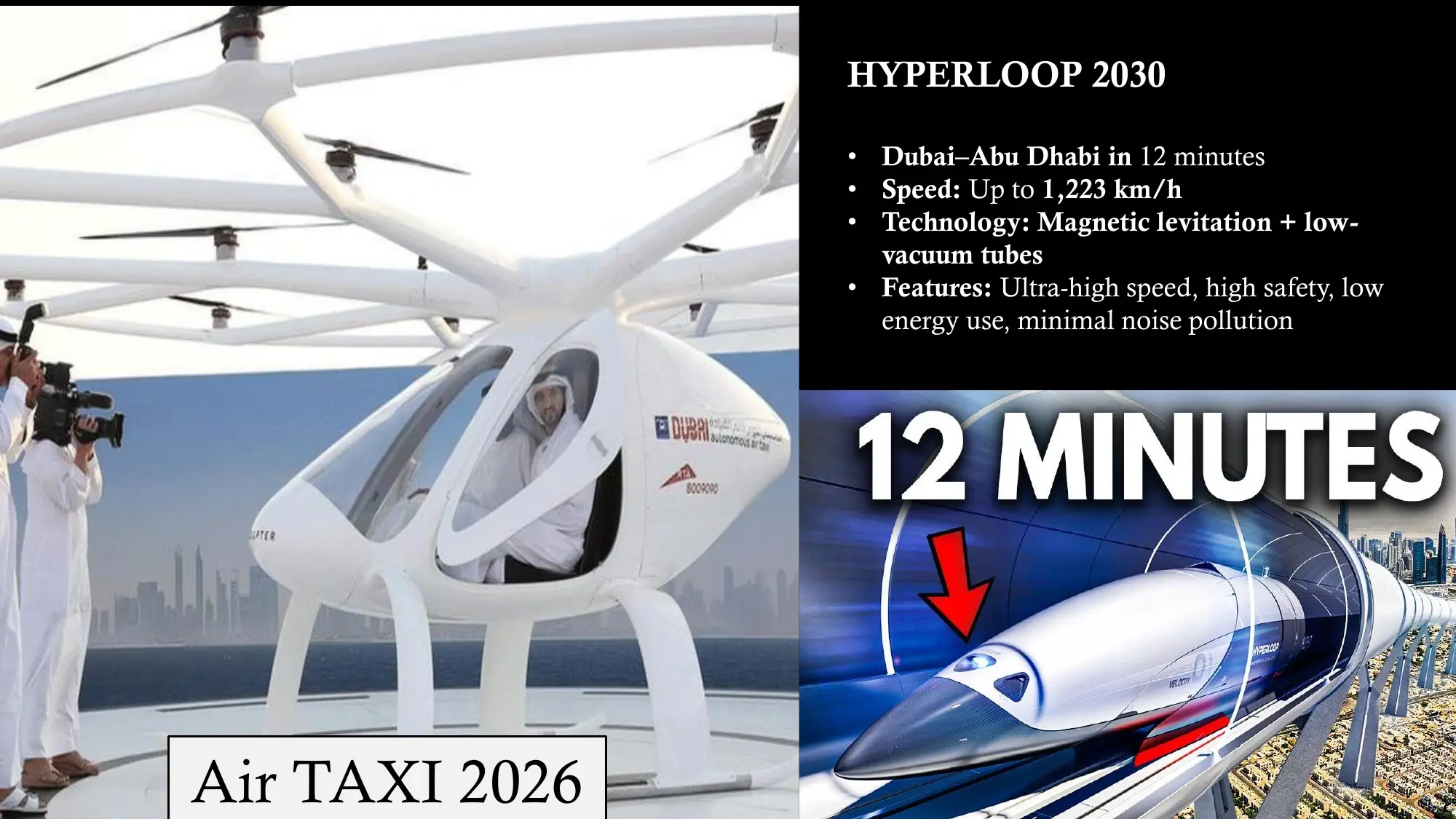
Air Taxi (2026) and the planned Hyperloop link
Al Maktoum International Airport
- Investment: USD 35.7 billion (~RMB 248 billion)
- Total area: 140 km² with 5 runways
- Annual passenger capacity: 260 million
- Annual cargo capacity: 12 million tons
- Logistics City: spans 21 sq km
- Parking: 100,000+ spaces
- Up to ~500,000 jobs across the Dubai South ecosystem
- ~1 million people supported by jobs and housing linked to the master plan
Real Estate: Exceptional Value Versus Global Cities
Across price per dollar, headline housing prices, and rental yields, Dubai consistently offers stronger value than comparable global financial centres.
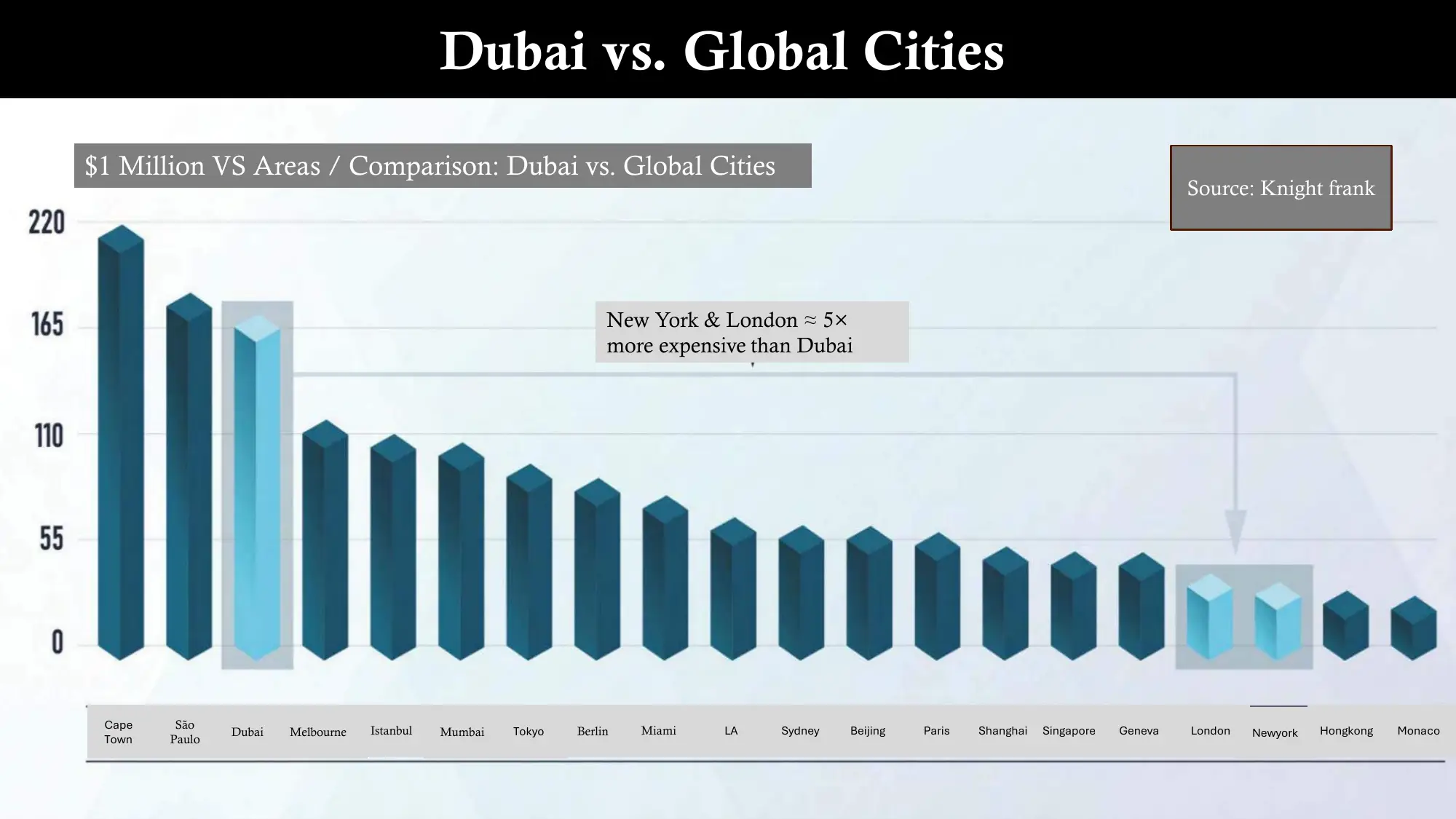
How much space USD 1 million buys: Dubai vs. global cities (Source: Knight Frank). New York and London are roughly 5× more expensive than Dubai
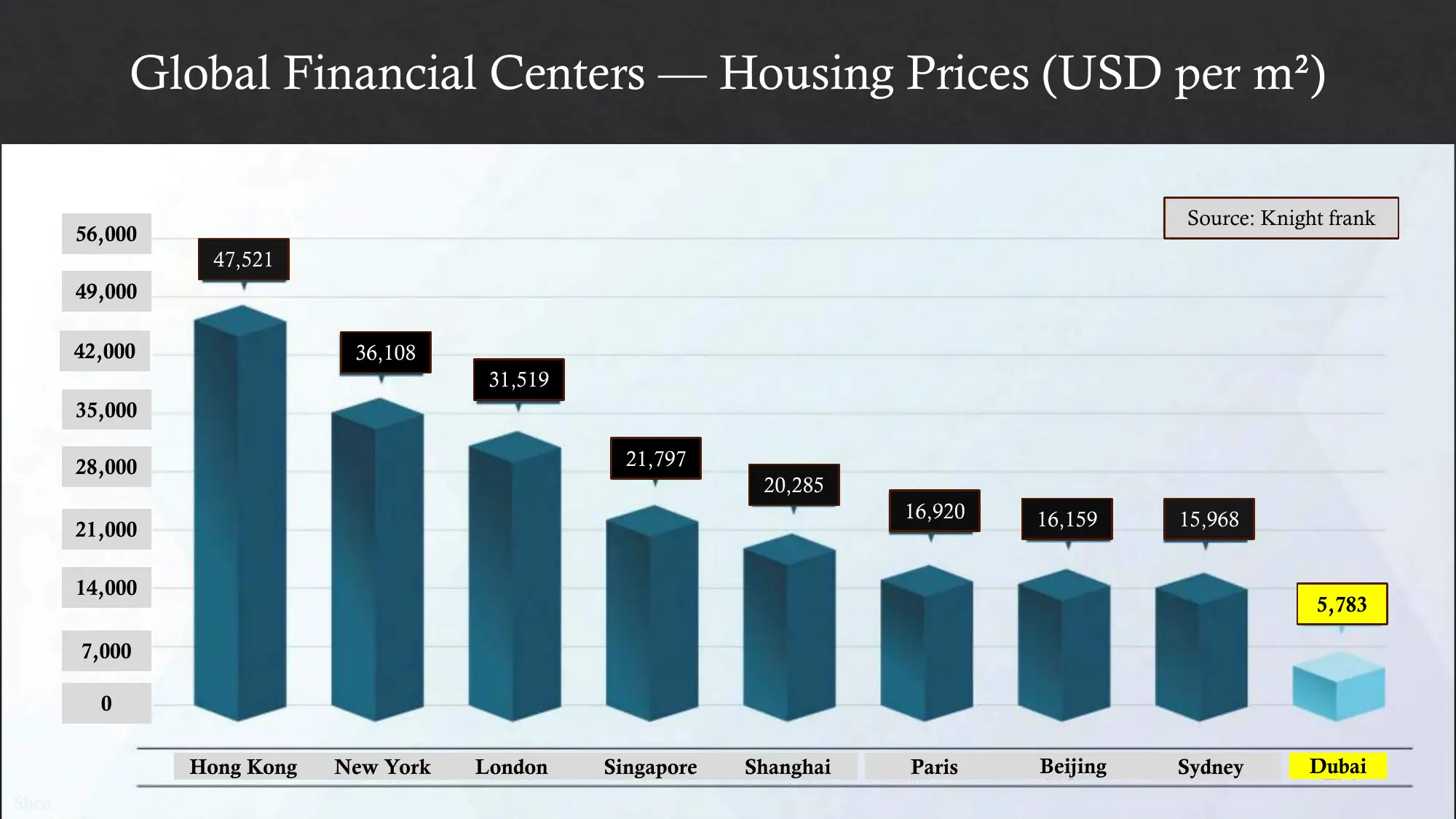
Global financial centres — housing prices (USD per m²). Dubai is the lowest at ~$5,783 (Source: Knight Frank)
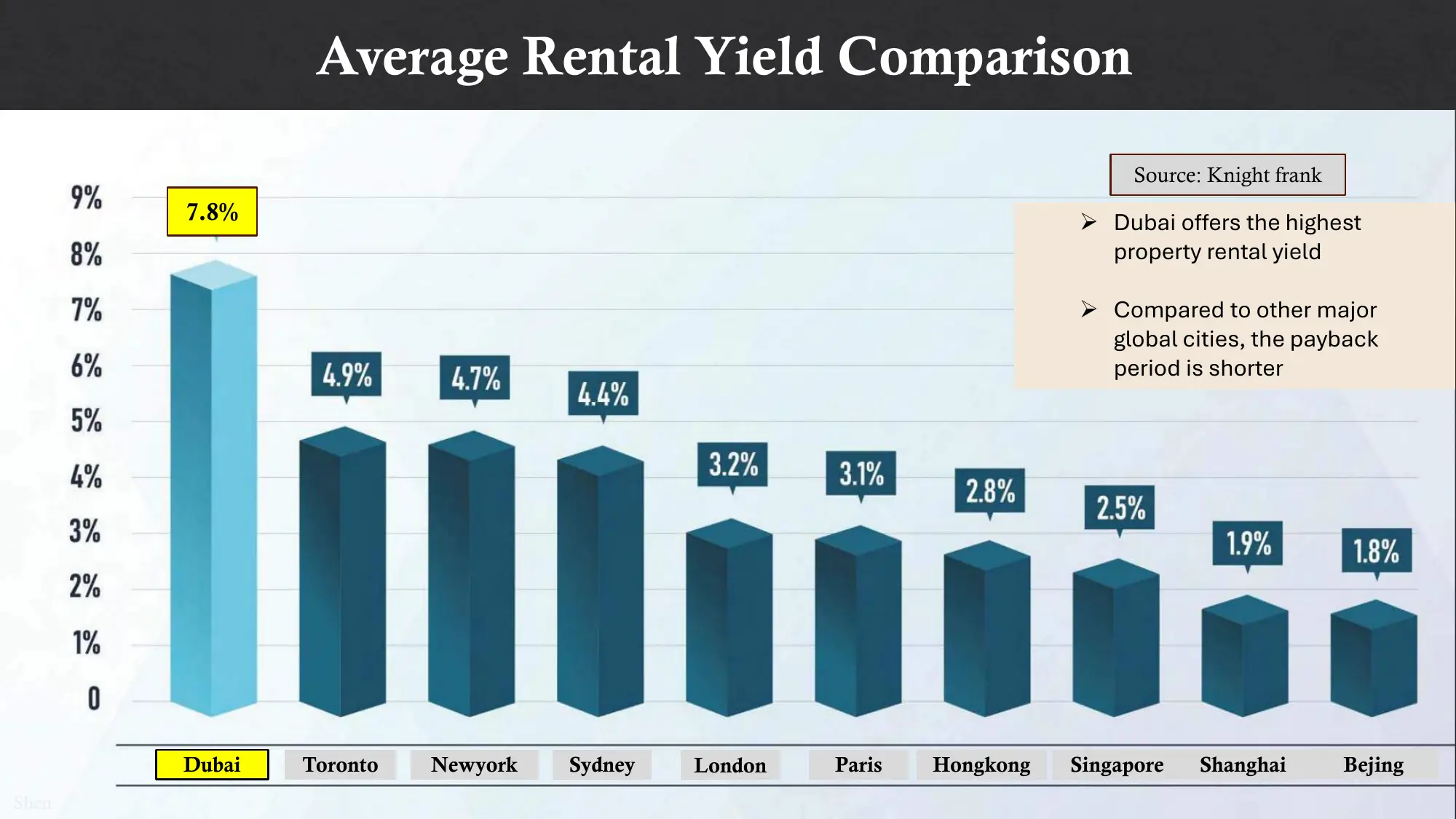
Average rental yield comparison — Dubai leads at ~7.8%, meaning a shorter payback period (Source: Knight Frank)
Investor Protection: The Role of RERA
The Dubai Real Estate Regulatory Agency (RERA), established in 2007, is the government body that regulates real estate transactions and ensures developers comply with property-sale regulations.
How the protections work, step by step:
- 100% freehold ownership
- Bank guarantee covering 50% of construction costs
- Contractor submits a 10% performance bond
- Developer pays 10% upfront to the contractor
- An escrow account is established under the project name
- RERA manages all escrow funds; payments are released only on project milestones, with 5% retained for 12-month post-handover maintenance
Property Prices vs. Rental Returns
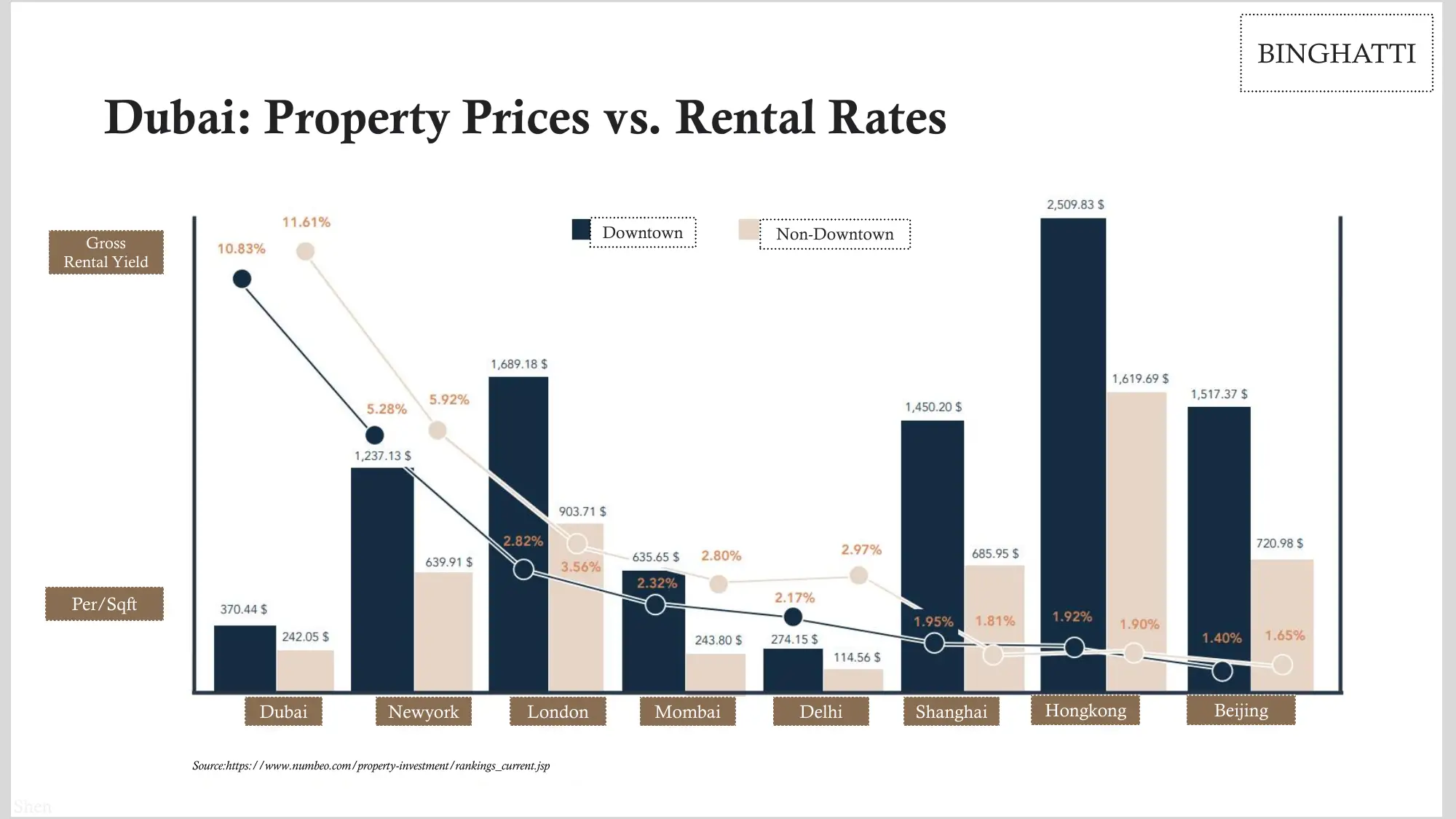
Property prices per sq ft against gross rental yield — Dubai pairs lower prices with the highest yields (Source: Numbeo)
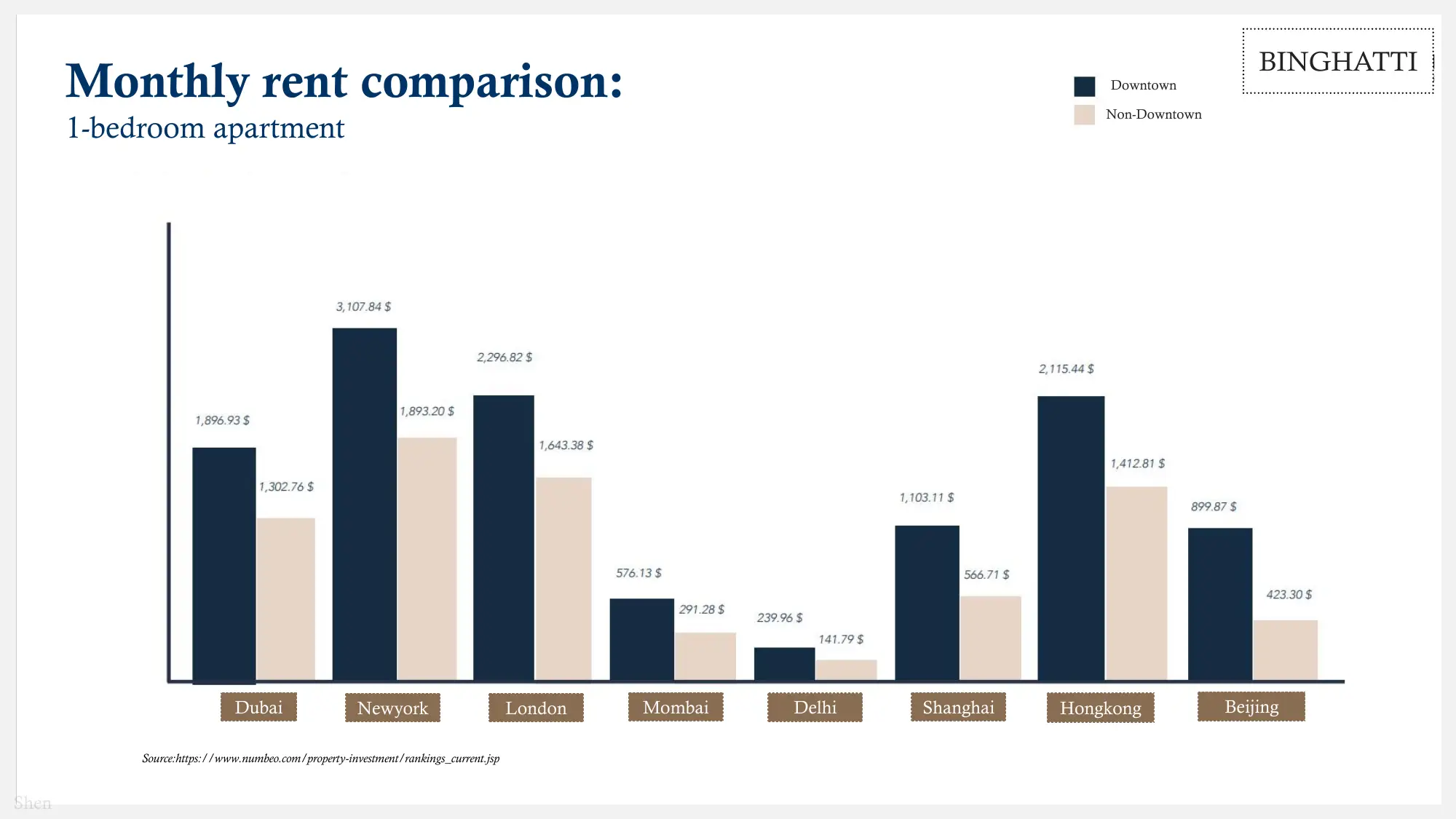
Monthly rent comparison for a 1-bedroom apartment, downtown vs. non-downtown (Source: Numbeo)
Real Estate Taxes & Fees: Dubai vs. Other Cities
Dubai’s cost of ownership is strikingly low. Aside from a one-time 4% transfer/registration fee, most property-related taxes are exempt — in contrast to the layered taxes and fees seen in other major markets.
| Dubai | New York | London | Sydney | Toronto |
|---|---|---|---|---|
| Transfer / registration fee: 4% | Luxury tax: 1% | Rental income tax: 20–45% | Stamp duty: 4–5% | Transaction tax: 1–2% |
| Other taxes: Exempt | Mortgage tax: 0.8–2.8% | Capital gains tax: 18–28% | Land tax | Property tax: 1–2% |
| Transfer fee: 1–6% | Inheritance tax: 40% above £325k | Mortgage fees | Land transfer tax: 0.5–2% | |
| Title search / insurance, lawyer & registration fees | Stamp duty, mortgage tax, council tax, lawyer fees | City infrastructure, sewer, lawyer fees | Land value tax, inspection, lawyer & loan fees |
A Stable, Low-Risk Market
- Bubble index approaching 0 — a stable and healthy market.
- Virtually no speculative bubble risk.
- Strong fundamentals support long-term growth.
- Low volatility in property prices and a positive outlook for investors.
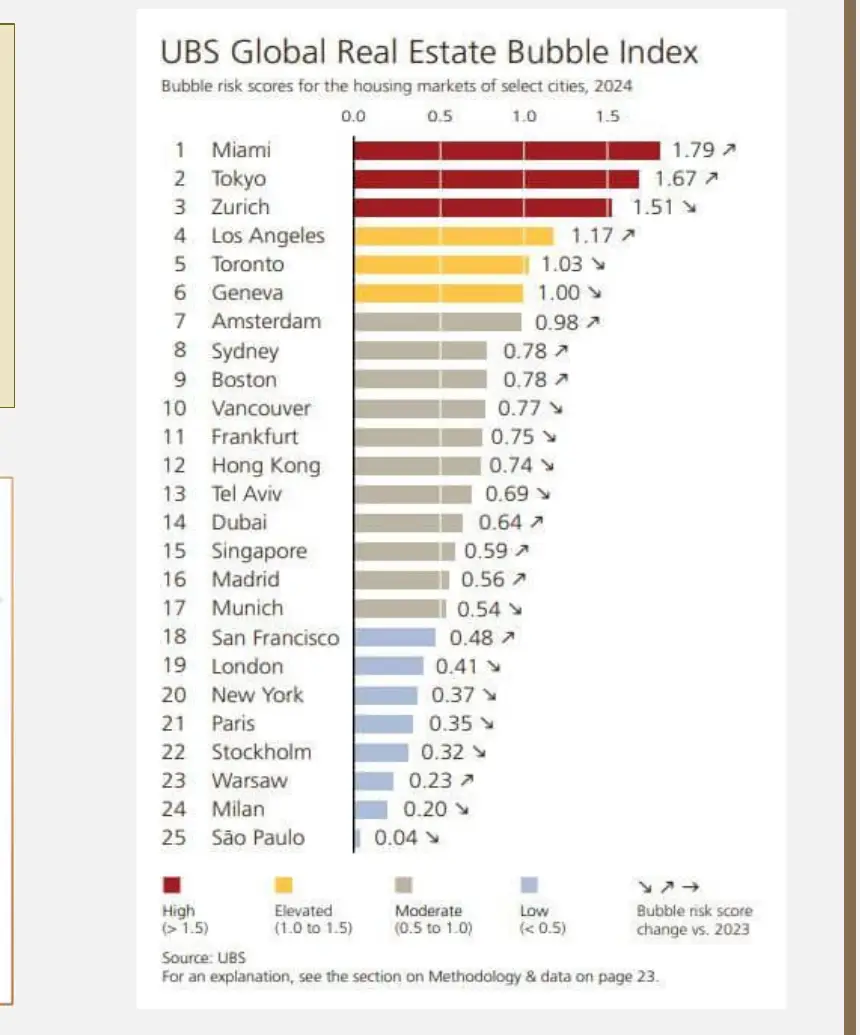
UBS Global Real Estate Bubble Index 2024 — Dubai sits in the moderate band at 0.64
Future Planned Property Supply
Dubai currently has a residential supply of around 840,000 units, expected to approach 1 million by the end of 2026. With roughly 383,000 units planned from 2025 onward, supply is projected to begin catching up with demand by 2028.
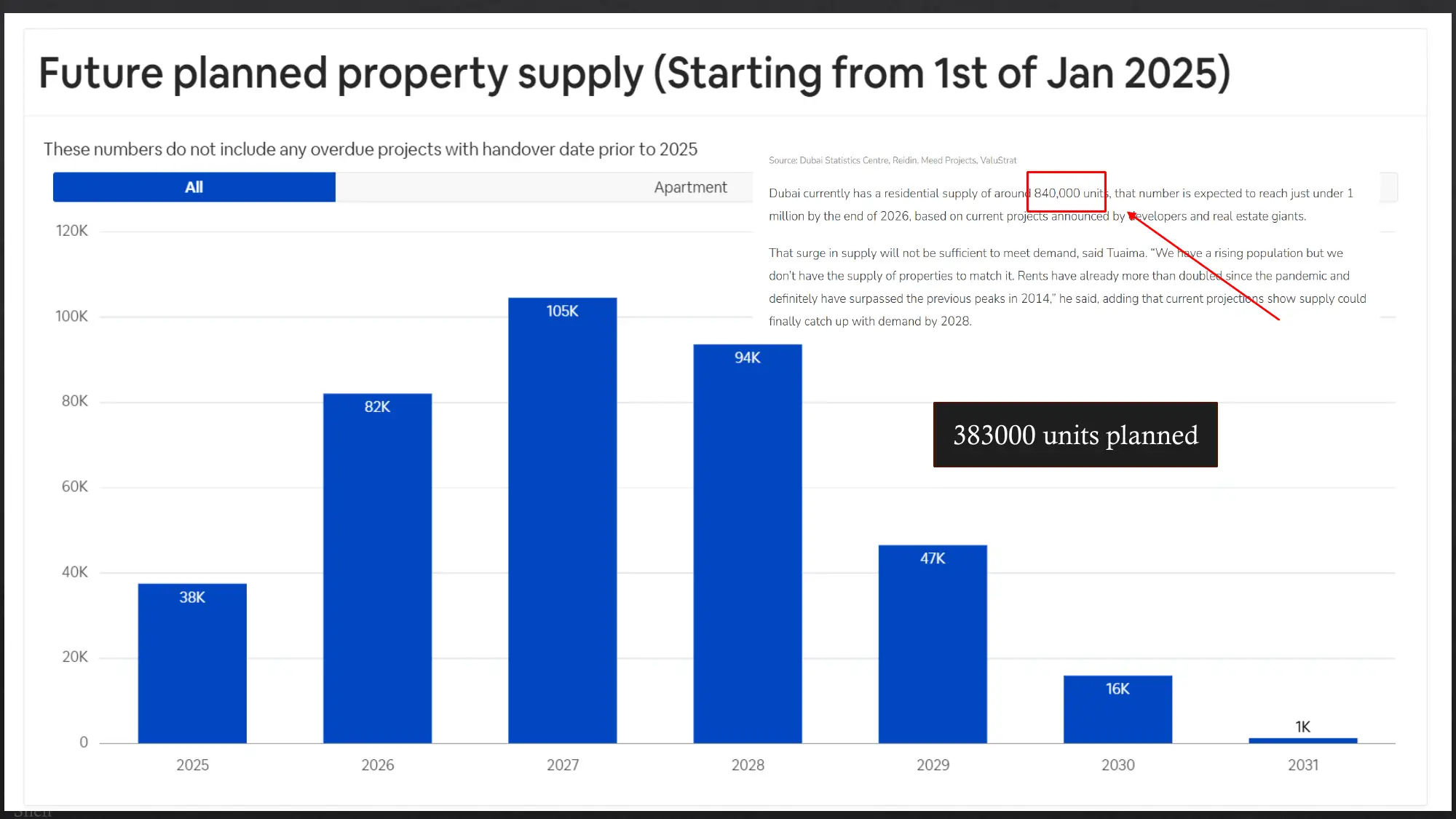
Future planned property supply by year, from January 2025 (Source: Dubai Statistics Centre, Reidin, Meed Projects, ValuStrat)
Sustained Population Growth
Dubai’s population has climbed steadily for more than a decade, reaching about 4.04 million in 2025 — continued demand that underpins the housing and rental market.
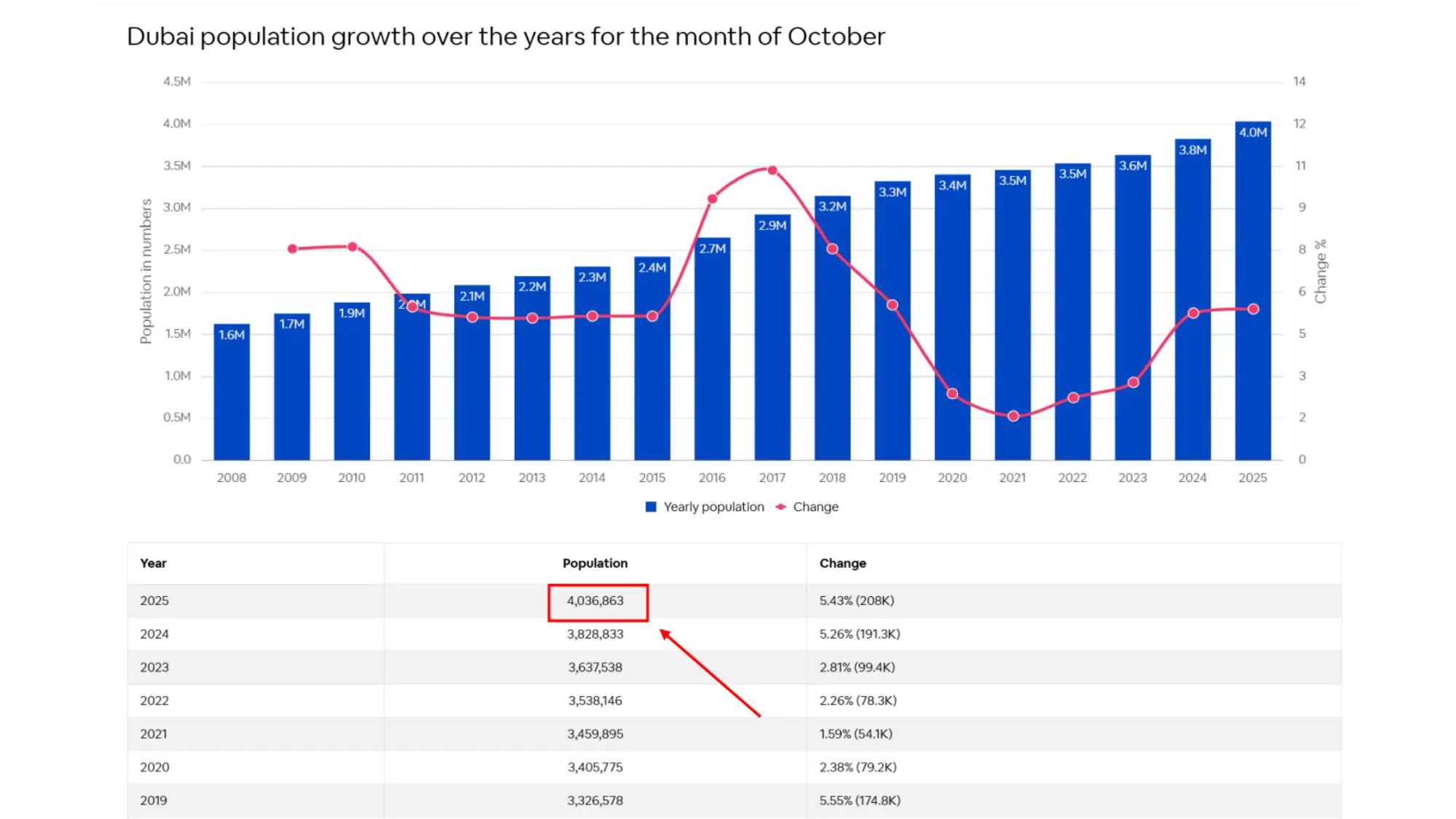
Dubai population growth (October figures), 2008–2025
| Year | Population | Annual change |
|---|---|---|
| 2025 | 4,036,863 | +5.43% (208K) |
| 2024 | 3,828,833 | +5.26% (191.3K) |
| 2023 | 3,637,538 | +2.81% (99.4K) |
| 2022 | 3,538,146 | +2.26% (78.3K) |
| 2021 | 3,459,895 | +1.59% (54.1K) |
| 2020 | 3,405,775 | +2.38% (79.2K) |
| 2019 | 3,326,578 | +5.55% (174.8K) |